Rebar Testing Machines – Tensile, Bend & Rebend
Universal testing machines configured for complete reinforcement steel bar certification: tensile testing, bend, rebend and elongation measurement. 50 kN to 2,000 kN.

Complete Rebar Testing Solutions for Construction Laboratories
Every test you need for reinforcement steel certification — tensile, bend, rebend, elongation — from one machine, one software, one manufacturer.
Reinforcement steel bars (rebar) must meet strict mechanical property requirements before they can be used in concrete structures. This includes tensile testing (yield strength Re, tensile strength Rm, elongation at maximum force Agt, Rm/Re ratio), bend testing (mandrel bending without cracking) and rebend testing (bend, age, reverse bend) — all defined by international standards.
Cermac’s UTM-H (hydraulic, 600–2,000 kN) and UTM-E (electromechanical, 50–600 kN) universal testing machines are widely used by construction laboratories, steel mills and rebar manufacturers for complete reinforcement steel certification. Combined with dedicated clip-on extensometers, the SP500 specimen marking machine and interchangeable bending mandrels, they form a turnkey rebar testing solution.
All machines feature 24-bit digital control, Cermac Testing software with pre-configured test masks for EN 15630, EN 10080, ASTM A615 and ASTM A370, and full Industry 4.0 connectivity for centralised data management across your laboratory.
Rebar Tests Performed
Tensile Test
Determines yield strength (Re or Rp0.2), ultimate tensile strength (Rm), Rm/Re ratio, elongation at maximum force (Agt) and elongation at fracture (A5, A10). Essential for classification and certification of B450C, B500B/C and all reinforcement grades.
Bend Test
Mandrel bending of rebar to a specified angle (typically 180°) around a mandrel of defined diameter. The bar must show no cracks on the tension face. Verifies ductility and surface quality.
Rebend Test
The bar is bent 90°, aged at 100°C for 30 minutes, then reverse-bent 20°. No cracks must appear. This test evaluates strain ageing susceptibility and weldability of the steel.
Agt Measurement
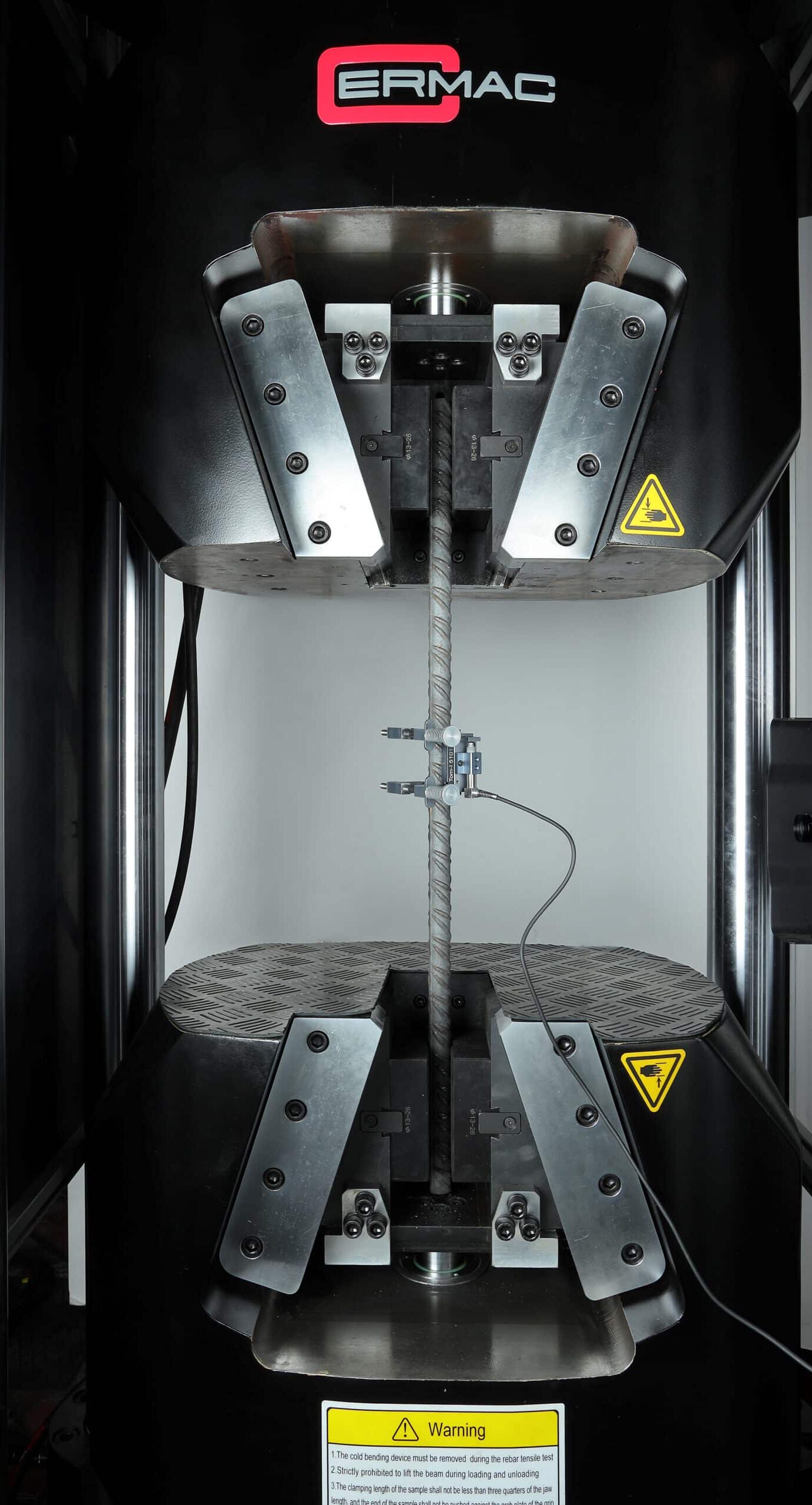
Total elongation at maximum force (Agt) is measured by clip-on extensometer during the tensile test. The Cermac Testing software automatically calculates Agt along with all other parameters.
A5 / A10 Elongation
Elongation at fracture measured manually on the broken specimen. The SP500 marking machine provides precise gauge length marks at 5, 10 or 20 mm intervals over 500 mm for accurate measurement.
Automatic Reporting
Cermac Testing software generates complete rebar test certificates with all required parameters, stress-strain curves, batch data and traceability — exportable and network-shared.
Rebar Testing Standards
Steel for the reinforcement and prestressing of concrete — test methods for reinforcing bars, wire rod and wire.
Steel for the reinforcement of concrete — weldable reinforcing steel — general requirements.
Standard specification for deformed and plain carbon-steel bars for concrete reinforcement.
Standard test methods and definitions for mechanical testing of steel products.
Tensile testing of metallic materials — the underlying test method used for rebar tensile testing.
Steel for the reinforcement and prestressing of concrete — test methods (international equivalent of EN 15630).
Rebar Testing Accessories
Everything you need for a turnkey rebar testing laboratory.
Hydraulic Wedge Grips
Self-clamping hydraulic grips with serrated jaws for secure, centred gripping of ribbed rebar from dia. 6 to 50 mm.
Clip-on Extensometer TOM-I
Contact extensometer for rebar with 0.1 µm resolution. Measures Agt, Rp0.2 and elastic modulus on round and ribbed bars up to 32 mm diameter.
Video Extensometer
Non-contact optical measurement. Ideal for rebar where surface ribs make clip-on mounting difficult. ISO 9513 compliant.
SP500 Specimen Marker
Permanent gauge length marking at 5, 10 or 20 mm intervals over 500 mm. For manual measurement of A5, A10 elongation after fracture.
Bend/Rebend Fixtures
Interchangeable mandrel sets for bend and rebend tests per EN 15630. Mandrels from 1d to 12d for all rebar diameters.
Charpy Impact Tester
ITM series (300–750 J) for low-temperature impact testing of rebar and weld specimens per ISO 148-1 and ASTM E23.
Applications
-
Steel mills — production quality control and certification testing of reinforcement bars, wire rod and welded mesh.
-
Construction laboratories — incoming material acceptance testing of rebar before use in reinforced concrete structures.
-
Third-party testing — ISO 17025 accredited laboratories performing rebar certification for multiple clients.
-
Precast concrete plants — verifying reinforcement steel properties as part of factory production control (FPC).
-
Prestressing strand testing — tensile testing of prestressing wires, strands and bars with TRF600 extensometer for 600 mm gauge length.
Why Cermac for Rebar Testing
Cermac has decades of experience equipping construction laboratories across Italy and internationally. Our machines and accessories are specifically optimised for the rebar testing workflow — from specimen marking to tensile testing with automatic Agt calculation to bend/rebend testing with interchangeable mandrels.
The Cermac Testing software includes pre-configured test masks for EN 15630, EN 10080, ASTM A615 and ASTM A370 with automatic calculation of all required parameters (Re, Rm, Rm/Re, Agt, A5) and certificate generation. Combined with Industry 4.0 connectivity, your entire rebar testing operation is traceable and auditable.
Frequently Asked Questions
What tests are required for rebar certification?
Tensile testing (Re, Rm, Rm/Re, Agt, A5), bend testing (180° mandrel bending) and rebend testing (90° bend, ageing, 20° reverse bend) — all defined by EN 15630, EN 10080, ASTM A615 and ASTM A370.
What load capacity is needed for rebar testing?
Small bars (8–16 mm): 100–300 kN. Medium bars (16–25 mm): 300–600 kN. Large bars (25–40 mm): 600–2,000 kN. Cermac covers the full range with UTM-E (50–600 kN) and UTM-H (600–2,000 kN).
What is the difference between Agt and A5 elongation?
Agt is the total elongation at maximum force, measured by extensometer during the test. A5 is elongation at fracture, measured manually on the broken specimen over a 5d gauge length. Both are required by EN 15630.
Can the machine also perform bend and rebend tests?
Yes. Cermac UTMs accept interchangeable mandrel bending fixtures for bend and rebend tests per EN 15630 and ASTM A615.
Is a specimen gauge length marker available?
Yes. The SP500 marking machine permanently marks gauge references at 5, 10 or 20 mm intervals over 500 mm for precise manual elongation measurement.
Machines & Accessories in Action
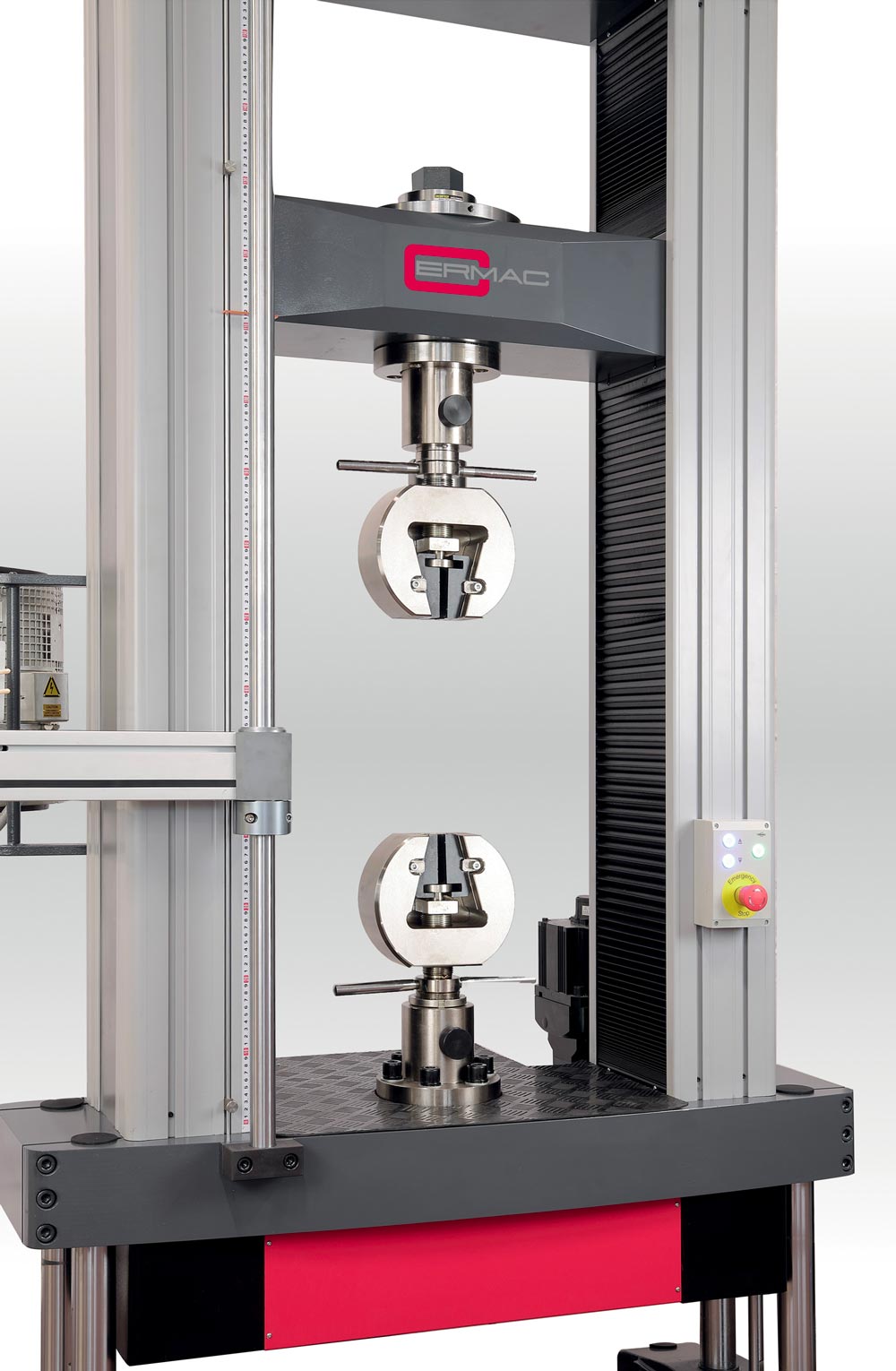
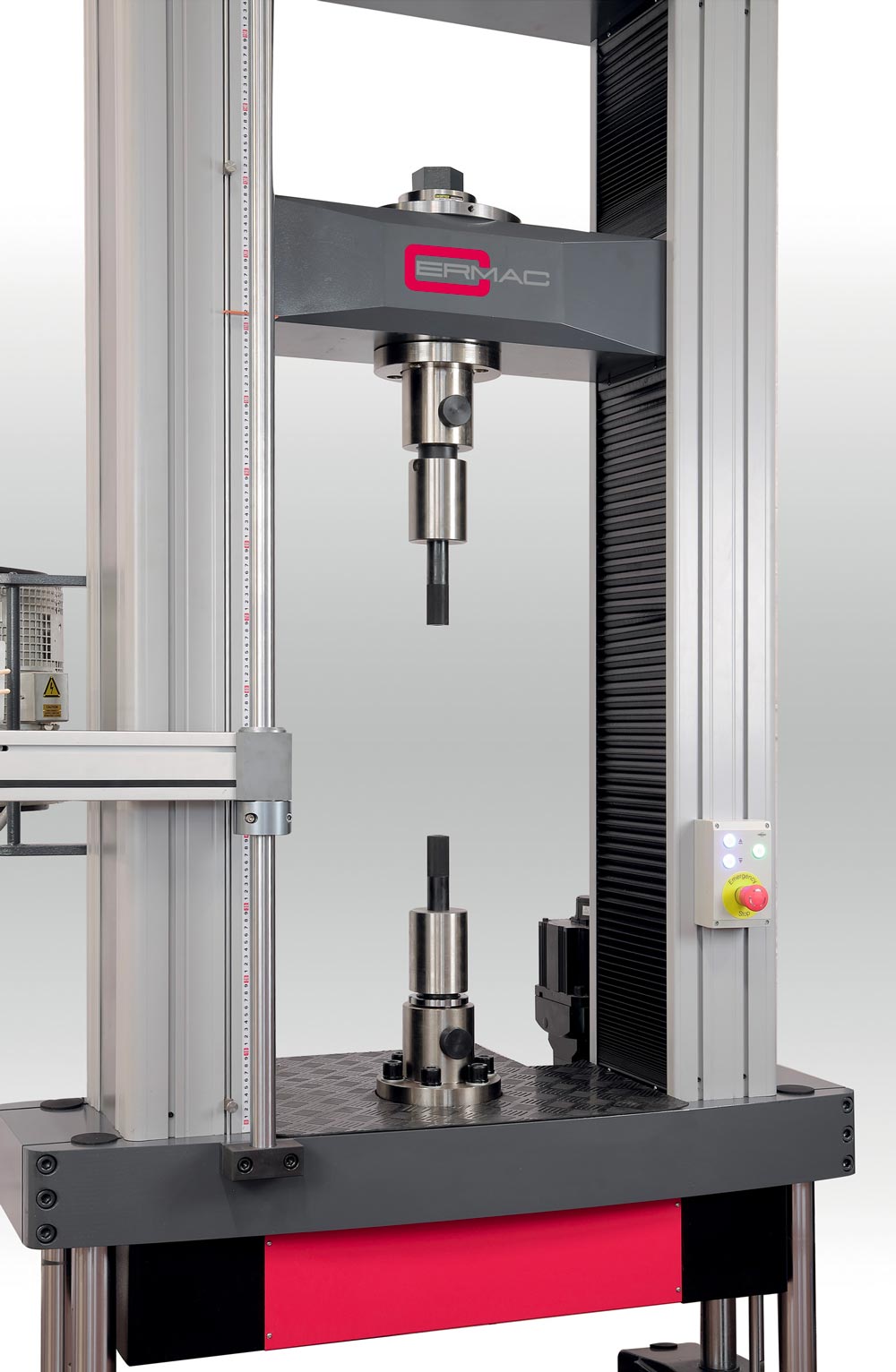
Cermac testing machines and accessories configured for real laboratory applications.
Tailored to Your Laboratory
At Cermac, every testing machine can be fully customised to match your specific requirements. From frame configuration and load capacity to grips, fixtures and software interfaces — we design the complete system around your laboratory’s workflow, materials and testing standards.
Our engineering team works directly with you to identify the optimal solution: the right machine, the right accessories and the right configuration to maximise productivity and ensure compliance from day one.
Every Cermac machine is compatible with a comprehensive range of dedicated testing accessories — extensometers, grips, furnaces, bending fixtures, impact accessories and more. Explore the full accessories catalogue →
Request a Quote for Rebar Testing Equipment
Tell us about your rebar testing requirements — bar diameters, standards, throughput — and our team will prepare a tailored proposal within 24 business hours.