
Home / Tensile testing on concrete
Tensile testing
Tensile testing on concrete
Tensile strength by splitting, flexural strength and post-cracking behaviour of fibre-reinforced concrete.
Why it is done
A small strength, but a decisive one
Concrete resists tension at about one tenth of what it resists in compression. That value governs cracking, bond of the reinforcement and durability, which is why it must be measured.
Direct tension on concrete is hard to carry out repeatably. In laboratory practice two indirect tests are used: splitting (the Brazilian test) on cylinders or cubes, and flexure on prisms.
For fibre-reinforced concrete the behaviour after cracking matters: the flexure test on a notched beam measures the crack mouth opening (CMOD) and gives the residual strengths that the designer uses in calculations.
What is measured
The parameters the test returns
The force-elongation curve gives the values required by product standards, certificates and specifications.
Indirect tensile strength by splitting
Flexural tensile strength
Load-CMOD curve in fibre-reinforced concrete
Residual flexural strengths fR,1-fR,4
Limit of proportionality

Reference standards
The most widely used standards
Tests are carried out on specimens cured in the laboratory or on cores taken from the structure.
- EN 12390-6: tensile splitting strength of test specimens.
- EN 12390-5: flexural strength of test specimens.
- EN 14651: concrete with metallic fibres, flexural tensile strength with CMOD measurement.
- ASTM C496 and ASTM C1609: splitting tensile strength and flexural performance of fibre-reinforced concrete according to American standards.
Learn more: post-cracking tests with a COD extensometer.
Machines and accessories
What you need in the laboratory
Machine, strain measurement and acquisition software: the configuration depends on the material, the specimen size and the standard. We define the grips together with you.
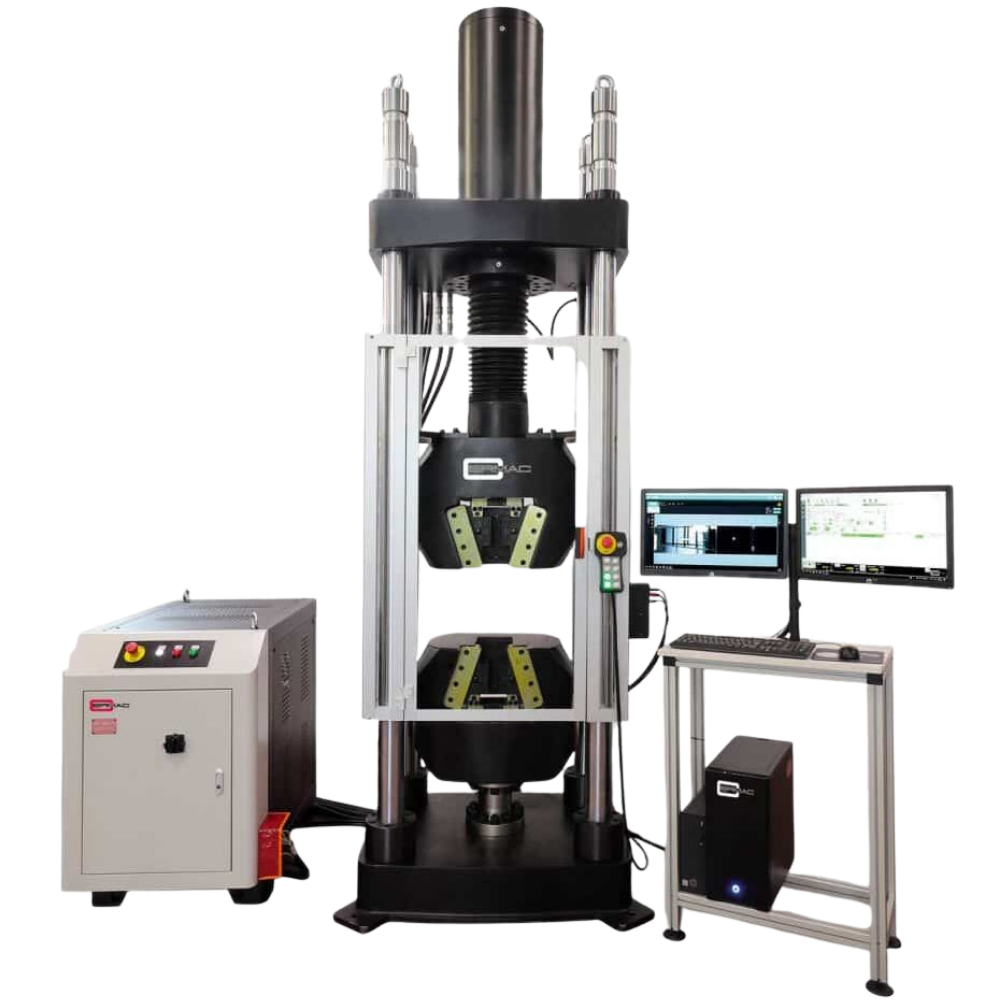
UTM-H Series
Servo-controlled hydraulic machines for tensile, compression, bend and flexure tests.
UTM-H
Capacity 600–2000 kN
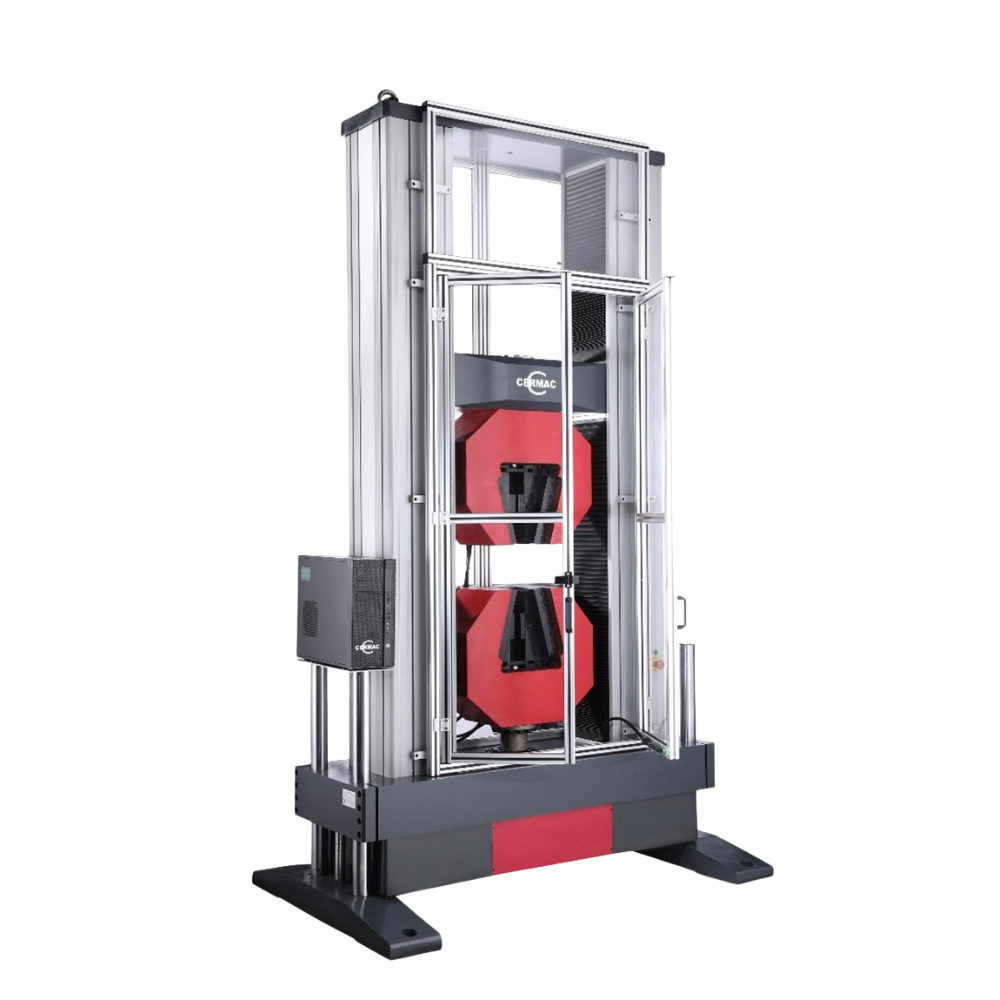
UTM-E Series 600 kN
600 kN servo-controlled electromechanical machine for high-strength materials.
UTM-E 600
Capacity 600 kN
Clip gauge
CMOD measurement in flexure tests on notched concrete beams.
EN 14651
Stroke 8 mm
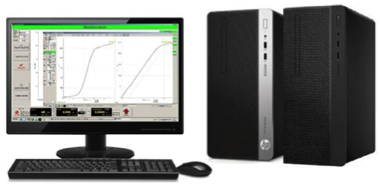
TestingXE system
CERMAC datalogger, firmware and software to acquire, store and certify the results.
TestingXE
Datalogger 24 bit
Frequently asked questions
Tensile testing on concrete
Why isn't direct tension used?
Because it is hard to grip a concrete specimen without breaking the ends or introducing parasitic bending. Splitting and flexure give more repeatable results and are the ones required by the standards.
What do you need for the EN 14651 test?
A machine with closed-loop control on crack opening and a CMOD transducer such as the Clip gauge, mounted across the notch.
Which parameters are obtained from fibre-reinforced concrete?
The limit of proportionality and the residual flexural strengths at different CMOD values, used to classify fibre-reinforced concrete in design.
Can I use a machine I already use for compression?
For splitting, often yes, with the right equipment. For EN 14651 you need closed-loop control on the CMOD: we will assess with you whether the machine can be upgraded.
Let's talk
Do you need to characterise a fibre-reinforced concrete?
Tell us the material, standard and specimen geometry: we will propose the right machine, grips and measuring system, which can also be integrated on a machine you already have.
TC
CERMAC Team · Applications & configuration
Replies within 24 working hours
Quality and accreditations

ISO 9001:2015
Quality system

CE marking
European conformity

EN ISO 7500-1
Force calibration

Made in Italy
In-house assembly

